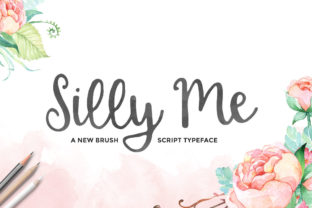
Silly Me: A Hand-Painted Brush Script Typeface for Editorial Design
As a publisher who crafts digital magazines, illustrated ebooks, and branded newsletters, I look for Script Handwritten fonts that carry personality without sacrificing clarity—and Silly Me delivers exactly that. This Fonts collection is not just another decorative script; it’s a hand-painted brush script typeface with over 115 hand-drawn characters, supporting a thoughtful range of languages and dialects. Its stylish, classic rhythm feels intentional—not trendy—making it ideal for projects where tone, trust, and tactile warmth matter.
Silly Me for Magazine Covers and Print-First Editorial Identity
When designing a quarterly lifestyle magazine or a limited-run literary journal, cover typography must signal voice before a single word is read. Silly Me excels here as a display font: its brush-stroke weight variation and subtle ink bleed create organic emphasis—perfect for titles like “The Quiet Season” or “Notes from the Coast.” Because it’s a Script Handwritten typeface with natural entry/exit strokes, it avoids the stiffness of digitized scripts while retaining legibility at 36–60pt sizes. For print workflows, I’ve used Silly Me in CMYK PDF exports with zero glyph fallback issues—especially valuable when working across English, French, Spanish, and Portuguese editions.
Silly Me for Ebook Titles and Chapter Openers in Digital Publishing
In EPUB and fixed-layout ebook design, display fonts need to render consistently across Apple Books, Kindle, and Adobe Digital Editions. Silly Me performs well as an embedded Fonts asset in reflowable titles and chapter headers—particularly when exported as OTF with full Unicode coverage. I’ve paired it with a warm serif (like Adobe Caslon Pro) for body text and reserved Silly Me strictly for frontmatter titles, part dividers, and epigraphs. Its classic styling avoids visual fatigue in longer reading sessions, unlike sharper or more exaggerated script fonts. As a Script Handwritten option, it adds editorial distinction without compromising accessibility on iOS or Android e-reader apps.
Silly Me for Newsletter Headers and Subscriber Engagement Graphics
For weekly creator newsletters—especially those featuring personal essays, seasonal guides, or reflective prompts—Silly Me strengthens reader connection at first glance. I use it exclusively for header banners (e.g., “This Week’s Letter,” “Your Spring Reading List”) and pull-quote graphics embedded in Mailchimp or Beehiiv campaigns. Its hand-painted authenticity signals care and craft—something subscribers notice subconsciously. Because Silly Me includes stylistic alternates and contextual ligatures, I rotate between variants across issues to maintain freshness without changing the core identity. And yes—it’s licensed for commercial newsletter use, including paid subscriber tiers and downloadable lead magnets.
Silly Me for Printable Workbooks and Coaching Guides
Whether designing a habit tracker, a mindfulness journal, or a client-facing brand workbook, Silly Me adds approachable authority. Its brush texture reads as human—not AI-generated—reinforcing the personal nature of guided content. As a Script Handwritten font, it works best for section titles (“Week One Reflections”), callout boxes (“Try This Today”), and signature lines—not dense body copy. For printables sold on Gumroad or Payhip, I confirm the license covers digital downloads and commercial resale—yes, Silly Me does. I also test output on home printers: its medium-weight strokes hold up cleanly at 100–120 DPI, with no pixelation or ink bleed distortion.
Silly Me for Multilingual Blog Headers and Global Content Branding
If your blog publishes in multiple dialects—or serves bilingual audiences—Silly Me stands out among Script Handwritten fonts for its inclusive character set. With over 115 hand-drawn glyphs covering extended Latin, diacritics, and common accented characters, it supports nuanced phrasing in Catalan, Vietnamese, Turkish, and Norwegian without switching fonts mid-header. That consistency matters: using Silly Me across language versions of a recipe blog or travel zine builds cohesive brand recognition. It’s not a “one-size-fits-all” script—it’s a considered typographic choice that respects linguistic detail.
Silly Me for Quote Graphics and Social Media Story Highlights
On Instagram and Pinterest, quote graphics stop scrollers—but only if they feel handmade, not templated. Silly Me’s irregular baseline and variable stroke pressure give each phrase visual breath. I layer it over muted watercolor textures or linen scans, then export as PNG with transparent backgrounds for Stories and Highlights. Because it’s a premium Fonts release—not a free Google Font—it avoids the “seen-it-before” fatigue of overused scripts. And since it’s optimized for screen readability at 24–48pt, quotes remain crisp even on small mobile displays.
Silly Me Paired with Serif and Sans Serif Fonts for Balanced Layouts
No Script Handwritten font lives in isolation—and Silly Me thrives when grounded by strong pairings. For editorial layouts, I default to a low-contrast serif (e.g., Literata or PT Serif) for long-form body text, letting Silly Me handle all display roles: headlines, subheads, and pull quotes. In digital-first newsletters, I pair it with a neutral sans serif (like Inter or IBM Plex Sans) for captions, buttons, and navigation—keeping hierarchy clear and loading fast. The contrast between Silly Me’s expressive flow and a structured companion font creates rhythm without chaos.
Silly Me for Wedding Guides, Lifestyle Ebooks, and Niche Printables
Within the creator economy, wedding planners, florists, and slow-living educators rely on distinctive typography to position their digital products. Silly Me fits naturally into this space—not as generic “cute” script, but as a refined, tactile choice for titles like “The Thoughtful Vow Guide” or “Seasonal Table Setting Workbook.” Its classic styling appeals across age groups and aesthetics, from modern rustic to quiet luxury. And because it’s a fully licensed Fonts package, I confidently embed it in Canva templates, Notion workspaces, and printable PDFs intended for resale.